/ 5 min read
I Won't Be Abducted: fixing what players couldn't read
A placement flow that passed its tests and ate clicks, a boss with bad instructions, and an economy that gave tools away. The September update.
The crafting menu opened. The tool went into your pocket. Then you clicked the board to place it, and nothing happened.
That was the first bug I chased after I Won’t Be Abducted shipped, and it set the tone for the whole September update. The others were quieter. Crafting worked but gave you far too much. The boss had a weakness and did a bad job of showing it. Adding a fourth night and more systems had exposed how much the game expected you to work out while aliens were hitting you.
The jam postmortem covers the weekend build and its cuts. This is about what changed afterward. Repeated playtests decided what needed another pass. The game now runs four nights, with a bigger room on the last two. Making those systems make sense took more work than adding them.
A passing test, a broken click
The placement bug was annoying because the placement logic was tested. Call the function directly and it worked. Click through the actual interface and it did not.
Decorative full-screen layers were swallowing pointer input before the board ever saw it. The test skipped the exact part that was broken. The regression check had to click, in the viewport, on the actual pocket button, instead of asking the placement function whether a cell was valid.
There was a design problem underneath the bug. Picking a recipe, finding its pocket, and choosing a cell while a Rusher charged you asked for too much attention. Crafting and placement now pause the fight. Legal cells glow, an invalid cell shows a cross, and a blocked placement leaves the tool in your pocket instead of eating it.
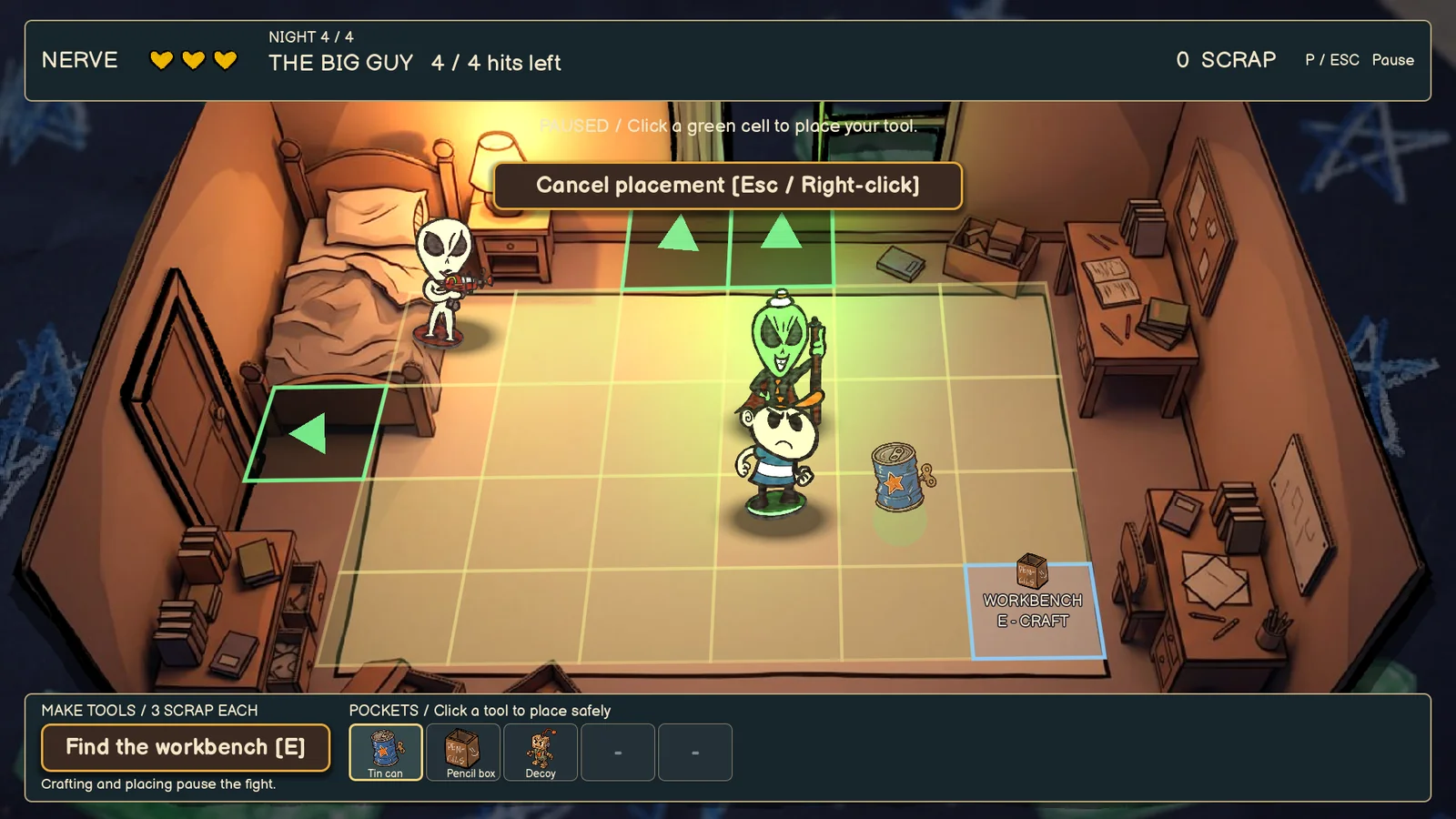
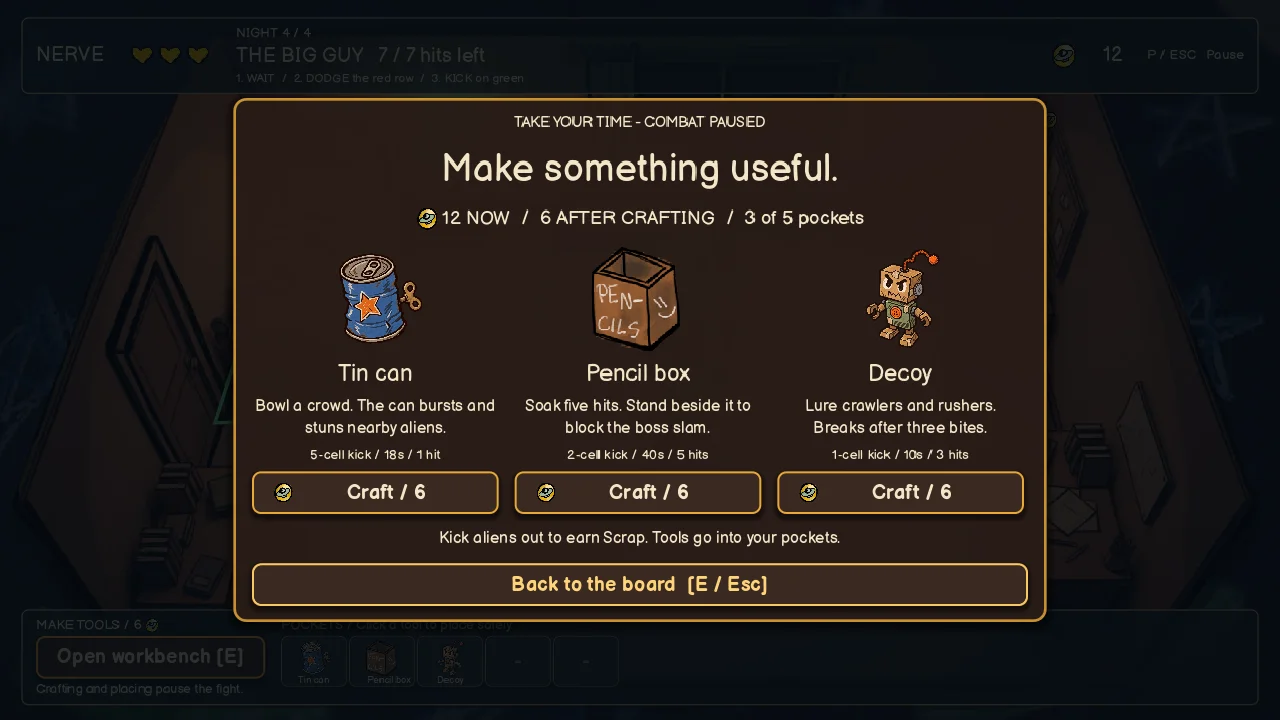
The workbench had to answer three things at once: what can I make, what does it cost, and what will I have left. Coin and item icons help. They only matter once the click underneath them is reliable.
The boss needed instructions on the board
The final boss had two opposite problems in a row. In the first expanded build, repeated kicks could end the fight almost immediately. Adding a guard and attack windows stopped that, and then nobody could tell when the opening was.
The cues now sit above the boss: WAIT, DODGE THIS ROW, KICK NOW. The threatened row is marked before the slam. During an opening, the free cells next to him light up with lines pointing at him, and a small countdown shows how long you have. He takes one hit per opening, seven openings total, and standing in the marked row costs a heart.
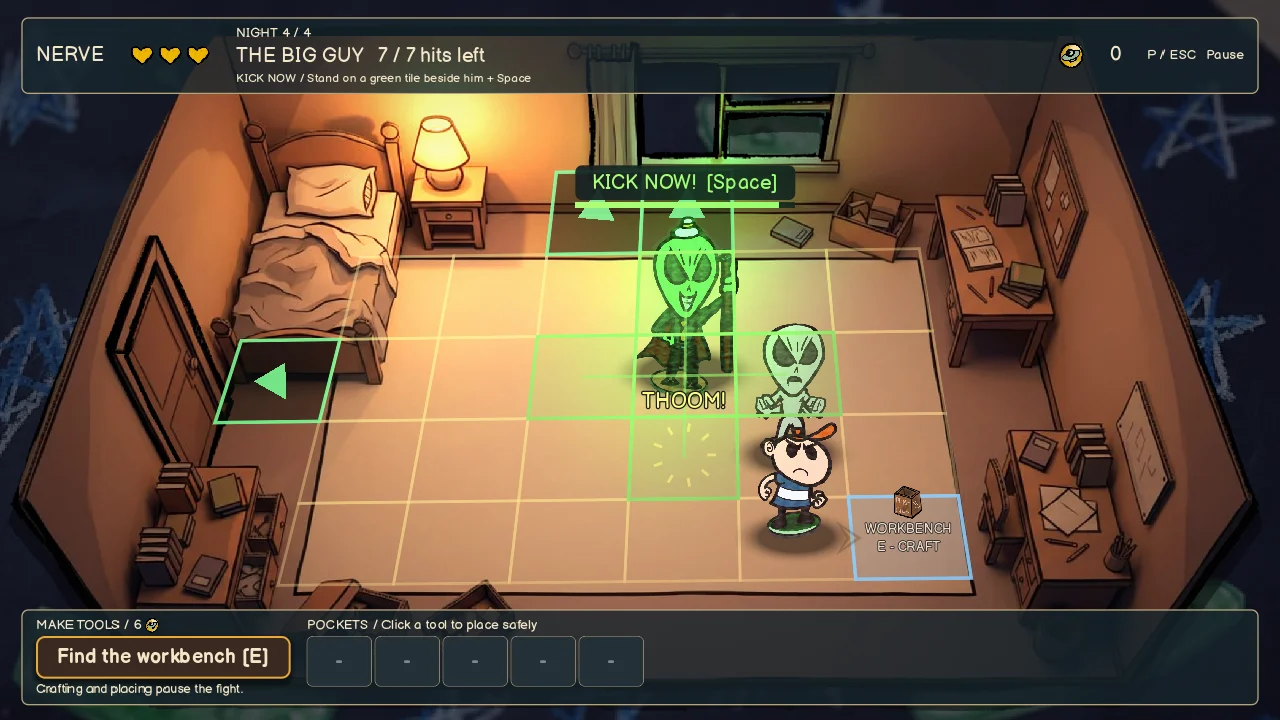
The change that worked was putting the instruction where you were already looking. A paragraph in a popup is useless when you are trying to leave a row and line up a kick at the same time.
Crafting was practically free
Cheap tools, frequent coin drops, and money from tool-assisted kills all fed each other. The decoy was the worst offender. Distracting the whole board bought enough time to do everything else.
Tools now cost six coins instead of three. Free coin drops come every thirty seconds instead of every twelve. Kills caused by bowling a tool into an alien no longer pay. And retrying a night restores its starting wallet and pockets, so a string of failed attempts cannot become a farm.
The tools also needed clearer reasons to exist. The can bowls a crowd and bursts to stun. The box soaks five hits and shields a neighbouring cell from the boss’s slam. The decoy pulls crawlers and rushers away and dies after three bites. Those roles give me something concrete to tune. If distraction still wins every decision, adding another recipe is not the answer.
Keep the jokes out of the player’s way
Enemy speech bubbles fit a game about a kid turning his bedroom into a siege. They also compete with instructions. Only one short bubble shows at a time, with a gap between them, and any chatter clears before the boss’s warning.
The visual changes follow the same restraint: faint paper grain, a soft vignette, dust drifting through the lamp light. The armoured alien’s bucket needed to look like part of the character rather than an icon stuck on top, and the loss screen now shows a toppled toy instead of a kid on the floor. The original drawings still set the look.
Ending spoilers: letting Dad in used to drop you at the menu. Now there is a short conversation and credits, so the joke has time to land: the invasion interrupted lunch, and your defence system is a pencil box. After all that effort keeping him out, the game needed a moment with him in the room.
What I still need to watch
Automated boss runs prove the fight can be won. They cannot tell me whether a person understands the first opening, notices a coin cost, or finds an alien’s line funny while dodging it.
So that is the next playtest: watch someone craft once and fight Dad without me explaining either system. If I have to lean over and say what to press, there is still work to do.