/ 4 min read
Silhouettes before commitments
The four-gate look test I run before any character or prop earns a place in a game.
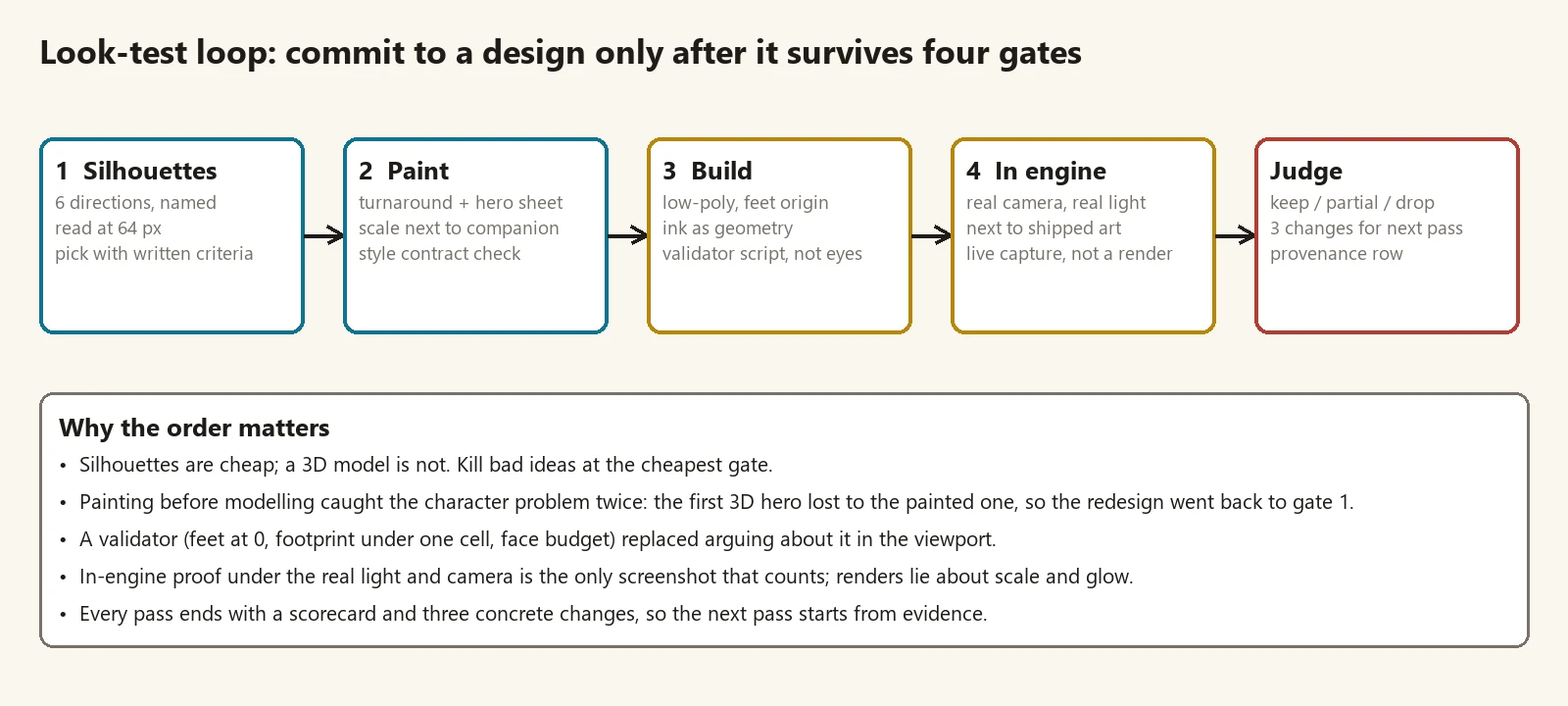
The most expensive art mistake I made this year was building a 3D hero before I had decided what he looked like. The model was competent. It was also the wrong character, and nothing about it survived once the design changed. Since then every character, prop, and world piece goes through the same four gates, cheapest first, and only leaves when it survives all of them.
None of the images here is finished game art. The point of the method is that finished art is the last thing you make.
Gate 1: six silhouettes, one pick
A silhouette is the cheapest possible version of a design, so it is where bad ideas should die. I ask for six directions, not six variations. Each gets a name and a one-line concept, and each has to be a different answer to the brief. “The Stooped Sentinel” and “The Bucket Helm” are different characters. Six antenna heights on one body are not, and when I got that back for the ThunderBashers robot I sent it back.
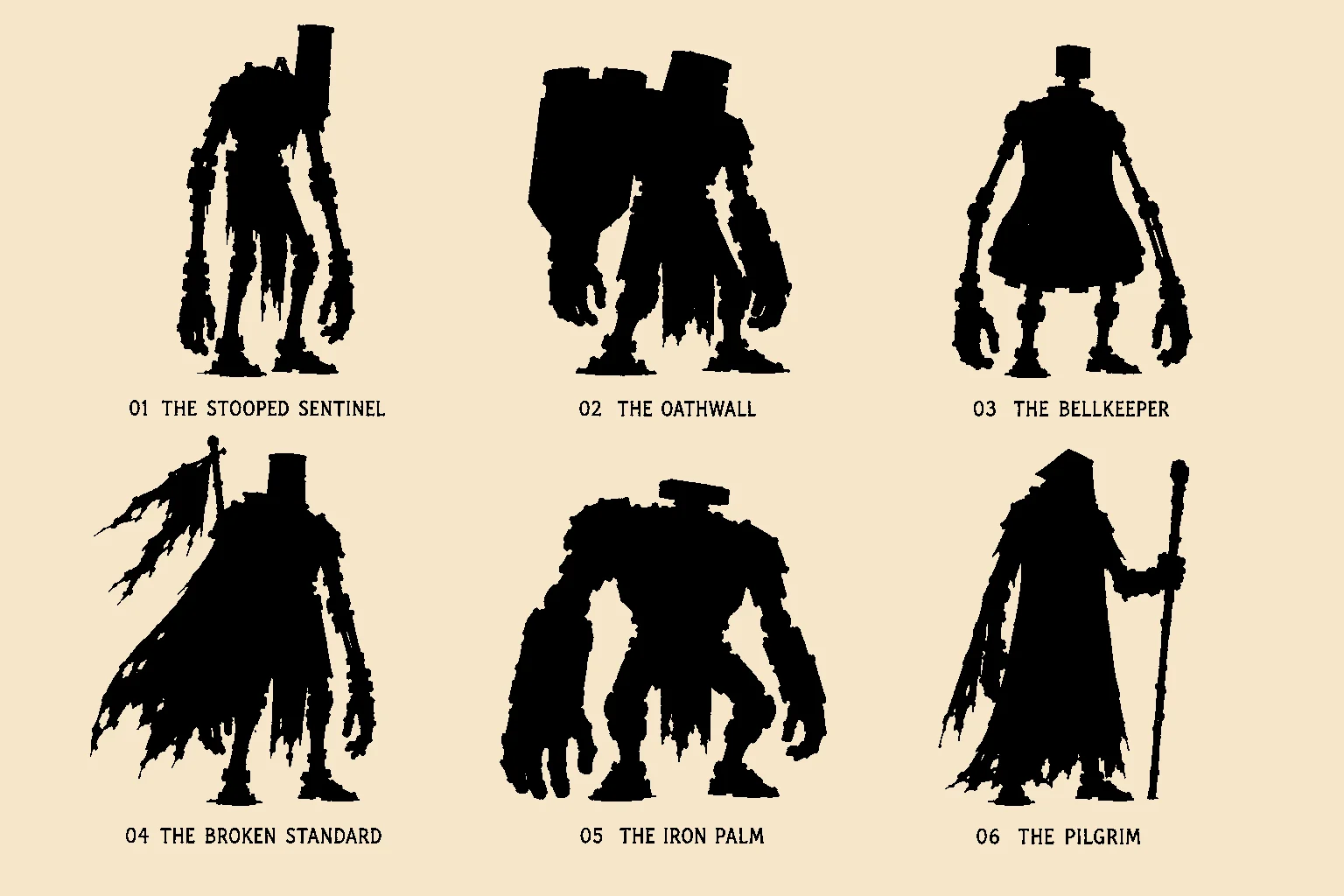
Every sheet includes a 64-pixel strip, because that is the size the character is on screen most of the time. Then I pick with written criteria and a score per direction: does it read as the thing it is in one glance, does it carry the emotional read the story needs, is it distinct from the generic version of its genre, and can a face live in it. Writing the criteria down does two things. It stops me choosing the prettiest drawing, and it gives the next pass a reason to argue with.
Gate 2: paint it next to its neighbour
The winner gets a turnaround and a hero sheet at game scale beside the character it will share the screen with. For Cog that meant standing him next to Wren, the human he protects. A design that looks good alone and wrong beside its companion fails here, and this is still cheap to fail.
The paint gate also checks the style contract: ink weight, flat fills with one shadow tone, palette, warmth. If the design does not sit beside the game’s existing art, no amount of modelling will fix it. For Spare Knight this gate is where I take over with a brush, because the shipped characters are painted and the new one has to match them.
Gate 3: build it, then validate it with a script
Only now does the design become an asset: a low-poly model with the outline as geometry, feet on the origin, footprint under one grid cell, a face budget. I stopped checking these by eye. A validation script imports each file, measures it, and prints a pass or fail per rule. Arguments about “it looks about right” in the viewport ended the day the script existed.
For a 2D game with a sprite rig the build gate is different but the principle holds: render from the game camera into the exact parts the rig expects, and validate the pivots against what the engine generates rather than what the export tool claims. That is how the ThunderBashers robots went from a model back into a seven-sprite rig within three percent of the original bounds.
Gate 4: in the engine, or it didn’t happen
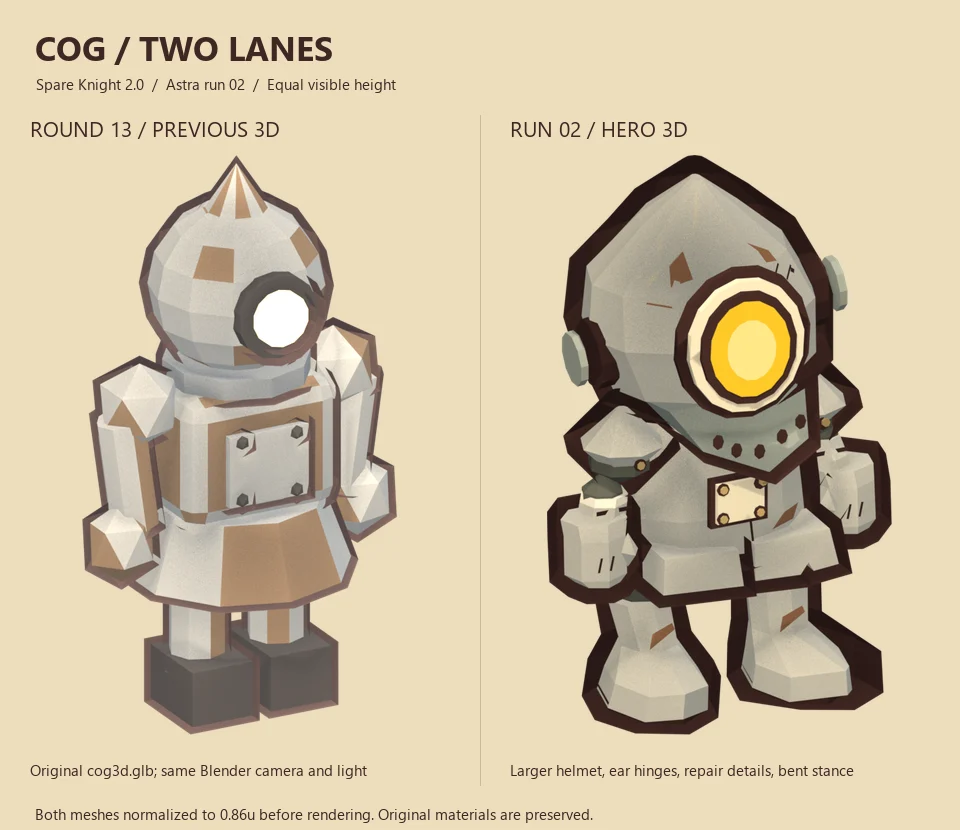
A render is not proof. Renders lie about scale, about how glow reads under real lighting, and about what the camera occludes. The only screenshot that counts is a live capture from the engine with the shipped art beside the candidate. Three times this year a 3D character that looked good on a turntable lost to a painted one under the real light. Each time the loss was obvious in the engine and invisible in the render.
The judgement
Every pass ends the same way: a scorecard with a number per gate, a verdict of keep, partial keep, or drop, and three concrete changes for the next pass. The three changes are the important part. They turn a rejection into a brief, and they mean the next pass starts from evidence instead of taste. The Cog redesign took three passes. The first produced a competent model of the wrong character. The second produced a better model of the same wrong character. The third started at gate 1 again, with a proper inspiration list, and produced a design worth painting.
What I’d keep
Kill ideas at the cheapest gate. Never skip the paint gate for a character, even when the model is the deliverable. Replace visual checks with a validator wherever a rule can be measured. And treat the three changes at the end of a pass as the real output. The asset is just evidence that the brief worked.